Indoor accidents don’t “just happen”-they happen when your puppy’s schedule and your training plan don’t match. Miss the early window and you’ll burn weeks scrubbing carpets, replacing pads, and arguing over “who forgot to take the dog out.”
After housebreaking hundreds of puppies with first-time owners and busy families, I’ve seen the same pattern: too much freedom, inconsistent timing, and punishment after the fact. That confusion teaches your puppy to hide, not to hold it-costing you time, money, and momentum.
This step-by-step plan gives you an exact daily routine, timing cues, and a simple tracking method to build reliable potty habits in days-not months-without harsh corrections.
24-Hour Housebreaking Schedule for New Puppies: Crate Timing, Meal Windows, and the Exact Potty-Trip Intervals That Prevent Accidents
Most housebreaking failures happen because owners wager on “they’ll signal” instead of enforcing a timed elimination rhythm; a young puppy’s effective bladder capacity is often 60-120 minutes when awake. If you miss one post-activity potty trip, you create a repeatable accident pattern within 48 hours.
| Time Block | Meals/Water | Crate + Potty-Trip Intervals (no exceptions) |
|---|---|---|
| 6:00-10:00 | Feed within 10 min of waking; remove bowl at 15 min; water available, then 30 min after morning meal. | Potty: immediately on wake, after eating, after drinking, after any play/training; otherwise every 60 min. Crate between trips; max crate stretch 2 hrs. |
| 10:00-18:00 | Second meal midday; last “free water” window ends ~2.5 hrs before bedtime (offer small sips if needed). | Potty: after nap, after meal, after drink, after excitement; otherwise every 90 min. Crate or tethered supervision between; max crate stretch 3 hrs. |
| 18:00-6:00 | Dinner early evening; remove bowl at 15 min; no large water after cutoff. | Potty: after dinner, after evening play, right before crating; overnight set alarm for 1-2 trips (every 3-4 hrs) until dry for 7 nights. |
Pro Tip: I had a client log wake/eat/drink/pee times in Puppy Potty Log and we found their “random” accidents were always 12-18 minutes after water-tightening that window eliminated them in three days.
Teaching a “Go Potty” Cue in 7-14 Days: Reward Placement, Outdoor Routine Design, and Proofing the Behavior in Bad Weather and New Locations
Most failed “go potty” cues are reinforced too late: if you treat after you’ve walked back inside, you’ve trained “return to the door,” not elimination. With tight reward placement and a repeatable outdoor loop, many puppies show reliable cue-to-pee in 7-14 days.
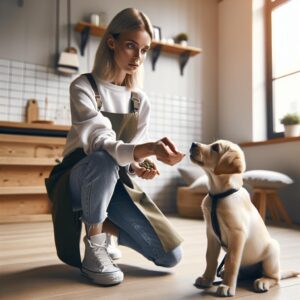
- Reward placement (timing + location): Say “go potty” once as the puppy starts sniffing; the instant they finish, mark (“yes”) and deliver 3-5 tiny treats on the ground at the potty spot, then release to 30-60 seconds of bonus sniffing to prevent “pee-and-dash.”
- Outdoor routine design: Use a short leash, walk directly to a designated surface, stand still for 2-3 minutes, then do a 20-30 second “reset loop” and retry; log attempts in Pupford to catch predictable windows (post-nap, post-play, post-meal) and schedule proactive trips.
- Proofing bad weather + new locations: Add gradual distractions (light rain, jacket, umbrella noise) while keeping the same cue, leash length, and reward; at new sites, recreate the same “potty square,” pay heavily for first success, then fade treats to intermittent reinforcement.
Field Note: One client’s cue stalled for a week until we moved treats from the back door to the grass itself-accidents dropped immediately because the puppy stopped sprinting indoors to “collect the paycheck.”
Accident-Proofing Your Home During Potty Training: Supervision Systems, Enzyme-Cleaning Protocols, and How to Fix Regression Without Punishment
Most “potty training failures” are scent failures: a single missed accident can leave sufficient odor cues to trigger repeat soiling in the same spot within 24-48 hours. The most common mistake is giving the puppy too much square footage before the supervision system is stable.
- Supervision system: Use an exercise pen + baby gate “airlock” to limit access; tether the puppy to you with a 4-6 ft leash during awake time, and crate when you can’t actively watch. Log outings, water intake, and accidents in Pupford to spot timing patterns and prevent “free-roam” relapses.
- Enzyme-cleaning protocol: Blot (don’t rub), saturate the full radius of the spot with an enzymatic cleaner, cover with plastic to keep it wet 10-15 minutes, then air-dry; repeat for old stains. Avoid ammonia-based products and steam cleaners-heat can set proteins/uric salts into fibers.
- Regression without punishment: Treat accidents as data-tighten space, increase outing frequency, and reinforce the next correct elimination within 2 seconds. If regression is sudden, rule out UTI/GI issues and re-check schedule changes (diet, sleep, new stressors).
Field Note: After a client stopped “spot-spraying,” fully saturated a favorite rug corner twice, and ran a 7-day leash-tether routine, the repeat-peeing hotspot disappeared by day 3 without a single scold.
Q&A
FAQ 1: How often should I take my puppy out, and what schedule works best?
Use a predictable schedule that matches puppy bladder capacity and learning speed. Take your puppy outside:
- Immediately after waking up, eating/drinking, playing/excitement, training sessions, and naps.
- Every 30-60 minutes when the puppy is awake during the first 1-2 weeks, then gradually extend as accidents decrease.
- Overnight: many puppies need 1-2 potty breaks at first; extend intervals as they reliably stay clean.
Rule of thumb for maximum bladder “hold” time is often cited as age in months + 1 hour, but treat it as a ceiling, not a goal. Consistency (same door, same spot, same cue) is what speeds learning.
FAQ 2: What should I do when my puppy has an accident indoors?
Respond in a way that prevents fear and builds the correct habit:
- If you catch them in the act: calmly interrupt (no yelling), pick them up or leash them, and take them to the designated potty spot. If they finish outside, reward immediately (treat + praise within 1-2 seconds).
- If you find it after the fact: do not scold-your puppy won’t connect it to the earlier behavior. Clean thoroughly with an enzymatic cleaner to remove odor cues that invite repeat accidents.
- Adjust the plan: accidents usually mean the puppy had too much freedom, too long between breaks, or missed supervision. Tighten management (crate/playpen/leash to you) and increase outdoor trips temporarily.
FAQ 3: Crate training vs. pads-will using pee pads confuse housebreaking?
It can, depending on your end goal and living setup:
- If your goal is outdoor-only potty: routine pad use may slow training because it teaches “indoor toileting is acceptable.” If you use pads short-term (e.g., high-rise, medical needs), place them in a consistent location and transition by moving the pad progressively closer to the door, then outside.
- Crate training: a properly sized crate supports housebreaking by leveraging a puppy’s natural desire to keep the sleeping area clean. It’s a management tool, not a substitute for frequent potty trips and rewards.
- Best practice: choose one primary toileting target (outside or pad) and reinforce it heavily to avoid mixed signals.
Wrapping Up: Housebreaking Your New Puppy: A Step-by-Step Training Plan Insights
Pro Tip: The biggest mistake I still see is giving a puppy “one free accident” and cleaning it with regular household spray-both teach the wrong lesson. Treat every miss as a management failure, then remove the odor with an enzymatic cleaner so you’re not fighting a scent map for weeks.
Right now, set a recurring timer on your phone for the next 7 days: after waking, after eating, after play, and before bed. Keep it ruthless and predictable.
- Place a leash and treat jar at the exit you’ll use every time.
- Start a simple log (notes app) with three columns: time, pee/poop, location.
- If you can’t supervise, confine-freedom is earned, not granted.

Dr. Ethan Caldwell is a pet wellness specialist and lifestyle expert dedicated to enhancing the quality of life for modern pets. With years of experience in animal care, nutrition, and behavior, he shares practical insights and premium living strategies to help pet owners provide healthier, happier, and more refined lifestyles for their companions.